Fannjiang
Compressed Sensing in Astronomical Imaging
Introduction
Compressed sensing, which proposes the recovery of sparse signals from highly sub-Nyquist sampling, is a recent advancement in signal processing that has always intrigued me. Just as image compression schemes like JPEG have helped lighten expensive data storage and transmission, compressed sensing could reform the expensive data acquisition that is an element of many modern imaging systems. (Romberg 2008 gives a great introduction.) For my project, I did a simple implementation of compressed sensing for an imaging system used in astronomy, known as radio interferometry. Early in the literature of compressed sensing, radio interferometry was noted in Wiaux et al. 2009 and others as an ideal candidate for application, as it conforms to the two principles compressed sensing works by. The first is signal sparsity, where most of the signal's coefficients are zero or near-zero in some transform space; the second is incoherence of the measurement matrix, or a property known as the restricted isometry property, where (roughly speaking) the underdetermined measurement matrix has columns that are "nearly" orthogonal. The measurement matrix in radio interferometry is in essence the "partial Fourier ensemble" described in Donoho 2006, or "the collection of n×m matrices made by sampling n rows out of the m × m Fourier matrix". The partial Fourier ensemble was one of the first measurement matrices proven to work well for compressed sensing, as shown in Candès et al. 2006, which makes radio interferometry a natural candidate.
"Sampling n rows out of the m x m Fourier matrix" leaves open the question of which n rows, however. In radio interferometry, the set of rows is determined by the placement of the radio antennas in the antenna array. Random sampling has proven to be critical to much of compressed sensing theory, which clashes with the highly patterned arrays used in radio interferometry such as the prominent Very Large Array (VLA). Wenger et al. 2010 noted this clash, and ran a few numerical simulations to see whether a randomized array or the traditional patterned array would work better for compressed sensing. The authors report that the VLA's patterned array actually outperforms a uniform random array, which I thought was interesting and somewhat counterintuitive. So for my project, I ran similar numerical simulations, with some deviations from the paper:
- I incorporated the discrete cosine transform (DCT) covered in class to represent images sparsely, whereas Wenger et al. just took advantage of the fact that radio images tend to be sparse in the pixel domain.
- I used orthogonal matching pursuit (OMP), a greedy compressed sensing algorithm, whereas the original paper used SparseRI, a compressed sensing recovery scheme the authors designed specifically for radio interferometry.
- I compared the VLA to a Gaussian array, as many of the massive up-and-coming interferometers like the ALMA seem to be centrally condensed as well as randomized, whereas the paper compared the VLA to a uniform random array.
To simulate signals from astronomical radio sources, I just took images the VLA has published on their website
Background
Imaging in Radio Astronomy
Interferometry is the definitive imaging tool of radio astronomy, allowing us to image finely structured radio sources such as galaxies, nebulas, and supernova remnants by using an array of many antennas to emulate a single lens. The aperture of the array is the greatest pairwise distance between antennas—which, at several kilometers for interferometers like the Very Large Array (VLA) in New Mexico, gives us far higher imaging resolution than a single lens could.

-
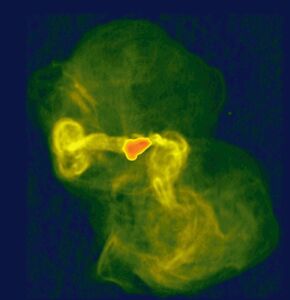 Radio emission of galaxy M87, imaged by the VLA. Courtesy of NRAO/AUI and F.N. Owen, J.A. Eilek and N.E. Kassim.
 -
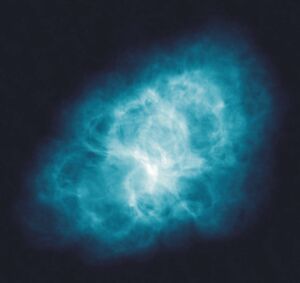 Radio emission of the Crab Nebula, imaged by the VLA. Courtesy of NRAO/AUI and M. Bietenholz.
 -
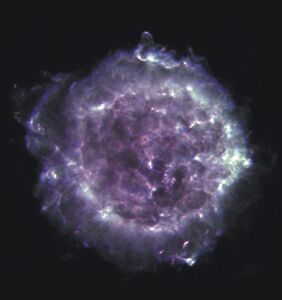 Radio emission of the Cassiopeia A supernova remnants, imaged by the VLA. Courtesy of NRAO/AUI.


Radio interferometry works by measuring the visibility function, or the interference fringes of the radio signal, at every pair of antennas in the array. The van Cittert-Zernike theorem gives the visibility function, as measured by one pair of antennas in the array, over the viewing window of the sky P as
where is the displacement vector between the two antennas, called the baseline, and is the intensity of the radiation from direction . In effect, the array samples the two-dimensional Fourier transform of the spatial intensity distribution of the radio source. Ideally, if we thoroughly sample the Fourier plane, we can invert the transform to reconstruct , the image of the radio source. However, the data acquisition quickly gets expensive, as we need to capture one Fourier coefficient per desired pixel in the image. The need to capture so much data has motivated a new generation of ambitious interferometers, including the Atacama Large Millimetre/submillimetre Array (ALMA), which will use 66 antennas, and the Square Kilometre Array (SKA), which will use several thousand antennas to probe the Fourier plane. Meanwhile, smaller interferometers like the 27-antenna VLA often sample over a period of time, allowing the rotation of the earth to synthesize "new" baselines as the antenna positions shift around the globe.
Despite such efforts, there are always irregular holes on the Fourier plane where sampling of the visibility function is thin or simply nonexistent. This data deficiency is currently managed by interpolating or filling in zeros for unknown visibility values, and applying deconvolution algorithms such as CLEAN to the resulting “dirty images”. However, is it necessary to collect so much data set in the first place?
Among imaging's most promising developments in recent years is the theory of compressed sensing (CS), which has shown that the information of a signal can be preserved even when sampling does not fulfill the fundamental Nyquist rate (Donoho 2006; Candès et al. 2006). The theory revolves around a priori knowledge that the signal is sparse or compressible in some basis, in which case its information naturally resides in a relatively small number of coefficients. Instead of directly sampling the signal, whereby full sampling would be inevitable in finding every non-zero or significant coefficient, CS allows us to compute just a few inner products of the signal along measurement vectors of certain favorable characteristics. (Here, the measurement vectors are the Fourier-like measurement vectors described by the van Cittert-Zernike theorem above.) The novelty of CS over image compression is that it takes advantage of image compressibility to alleviate data acquisition, not just data storage.
Astronomic images are often sparse or compressible—indeed, they are often sparse in the natural pixel basis, due to the black background of space. Recent studies such as Wiaux et al. 2009 have recognized the natural agreeability of radio interferometry with CS, comparing the its performance to the traditional CLEAN algorithm.
Compressed Sensing
Methods
Results
Conclusions
References
Candès, E., Romberg, J., and Tao, T. Robust uncertainty principles: Exact signal reconstruction from highly incomplete frequency information. IEEE Trans. Inform. Theory, 52:489 - 509, 2006. [1]
Donoho, D.L. Compressed sensing. IEEE Trans. Inform. Theory, 52:1289 -1306, 2006. [2]
Romberg, J. Imaging via compressive sampling. IEEE Signal Proc. Mag., 25:14 - 20, 2008. [3]
Wenger, S., Darabi, S., Sen, P., Glassmeier, K., and Magnor, M. Compressed sensing for aperture synthesis imaging. Proc. IEEE International Conf. on Imag. Proc, 1381, 2010. [4]
Wiaux, Y., Jacques, L., Puy, G., Scaife, A.M.M., and Vandergheynst, P. Compressed sensing imaging techniques for radio interferometry. Monthly Notices of the Royal Astr. Soc., 395:1733 - 1742, 2009. [5]